
CME 101 for New Attending Physicians
The Stuff that No One Teaches You

What is CME?
It stands for Continuing Medical Education.
You don't have to worry about it as a resident because everything we do is medical education, from weekly lectures to on-shift learning to conferences.
But once you graduate, you have to prove to state boards that you are, in fact, continuing your education.
all new graduates, please scroll to the bottom for an important PSA
Does everyone need it? If you're a practicing physician in the United States, yes.
Who tracks it? Who ever checks it? You have to track it, and you have to be able to produce the appropriate amount of CME when asked. Generally it is your state medical board(s) that will ask for it. Each state has different requirements and you must keep your CME up-to-date. You may never get audited and asked, it's true, but...
But when you apply for a state medical license, it is with the understanding that you abide by their CME requirements. And so if/when you get audited, you must be able to produce records of all the CME that you reported doing.
How much CME do I need? Since it's different for every single state, I'll just give a few examples. There are websites that aggregate the amount of CME you need, but it's always safer to go to the source.
Let's take Kentucky for example. You will find the requirements very clearly on their website.
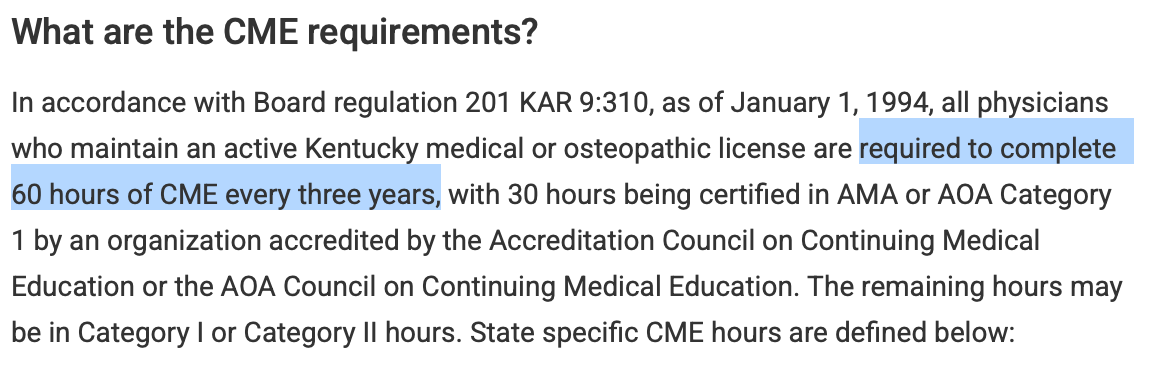
So 60 overall CME credits every 3 years. A minimum of 30 must be Category 1 (more on that later).
They go on to specify the following (for my specialty, specifically):
- 4.5 hours of substance use, addiction, safe opiate prescribing, etc.
- 1 hour on pediatric abusive head trauma
Other specialties, such as primary care, might need to do additional specific CME (like education related to domestic violence).
Let's take a look at another random state: Texas

So in contrast, they require 48 credits every 2 years, of which half (24) must be Category 1 (see below). Of these 24 Category 1 hours:
- 1 hour of human trafficking prevention education
- 2 hours of formal pain management and opiate prescribing
- 2 hours of medical ethics
As you can see, each state is different. This, and the state fees, are usually why physicians don't keep state licenses that they don't regularly use.
What is Category 1 vs. 2 when it comes to CME?
Generally, Category 1 credits are formal education. The highest level of credit that you'll see advertised by conferences, for instance, is American Medical Association Physician’s Recognition Award Category 1 Credit. Phew. That's a mouthful. Often you'll see AMA PRA Category 1 for short.
In order to be able to offer these, the entity (institution, lecturer, etc.) had to apply and go through some rigorous requirements. These credits are awarded by the Accreditation Council for Continuing Medical Education (ACCME). It's not cheap to offer CME and so it can cost money to partake in it.
The Texas state board describes Category 2 CME as being "composed of informal self-study, attendance at hospital lectures, or grand rounds not approved for formal CME or case conferences."
How do you get CME? There are so many ways. They range from lectures, conferences, workshops, newsletters, articles, even podcasts.
What counts? In order to be able to offer official CME, a program has to go through verification: this means that not every single educational thing you see online counts as CME. It has to be validated.
For instance, if you attend a conference, they'll often ask you to submit a CME request form, and then they send you back a file with your hours. The conference schedule will say which lectures are not CME-eligible (for instance, talks given by pharmaceutical companies won't be eligible, as there may be a conflict of interest).
Courses like ACLS/ATLS/BLS all count towards CME and you can get documentation proving it.
Conferences:
Most large national and international conferences (ACEP, AAEM) offer CME for attending their lectures. Smaller conferences (I attended ResusX, which was fantastic) also offers CME credits. You have to request this and they email you over the form, which you then save.
There are also CME-specific conferences. These are slightly different because they aim to combine obtaining CME with vacation. Here's an example:
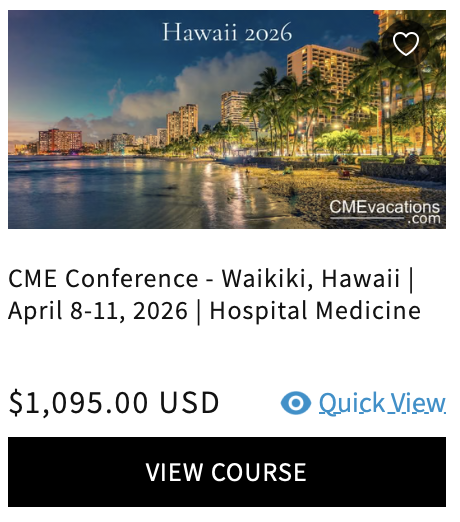
I am by no means endorsing these types of conferences (I haven't been on any myself, so I'm not sure of the quality), but once you know they exist you can look them up for your specialty and see if it's worth the money. Check Reddit and talk to your peers to get honest reviews.
Mandatory credits:
For states that have specific requirements (like 1 hour of pediatric head trauma training), they often offer these for free. So you can go on the state board website and complete the education on there, and save it.
How do you pay for CME? It depends!
If you're a traditional W2 employee, chances are that your contract includes CME money. This is usually a set amount ($1,500-$3000) that you can spend on CME-related activities and then you send in your receipts and get reimbursed.
CME money can actually be used for a lot more than just CME credits: depending on the institution, this can be anything that goes towards a home office (a laptop, desk, etc.), a point-of-care ultrasound or other technology (otoscope, etc.) or even scrubs. The important thing is to keep your receipts so you can get reimbursed. When you're looking at contracts for a new job, definitely see if there's room for negotiation when it comes to your CME budget.
If you're a 1099 employee like me (i.e. a contractor), you pay for your own CME. These are all considered business expenses, meaning that whatever you spend, you can deduct from your business income and minimize your taxable income. If you attend a medical conference, this includes everything from flights, hotel, conference registration fee, rental car needed to get around, even 50% of meals potentially. There's a bit of nuance and this is not tax advice by any means, as I'm still learning, but it's one of the perks of being a contractor.
If you're paying for a lecture series or newsletter, that's all tax-deductible.
Questions from the audience (that's you!):
How much should a CME credit cost? This is actually my question that I asked you guys (no one answered, whomp) because a newsletter was offering a CME subscription: $395/24 credits which comes out to $16.45/credit. I'm not sure if that's worthwhile, but considering that conferences can cost ~$1,500 with flight, hotel and fees for similar credits, perhaps it's not too bad.
Here's the newsletter in question:
 Med Mal Reviewer
It has a free option, a paid option, and a CME option, which (when it's not on sale) is $465 a year. (Side note: I highly recommend this for all young attendings - extremely well-written and insightful, regardless of the specialty you're in.)
What are some other ways to get CME?
You can use UpToDate and get "passive" CME as you search for things during your day-to-day! (See below.)
One of my attendings told me a few years ago that for him, attending conferences to get CME is just not worth the money. He gets very little actual value (as some of these lectures tend to be repetitive) and you have to spend 3-4 days and a ton of money.
So he recommended AudioDigest, which is an on-the-go way of obtaining CME and I looked into it. The details are below, for those interested. (Again, this is not an ad or an endorsement, just some options. Let me know if you use one of them - would love to hear feedback.)
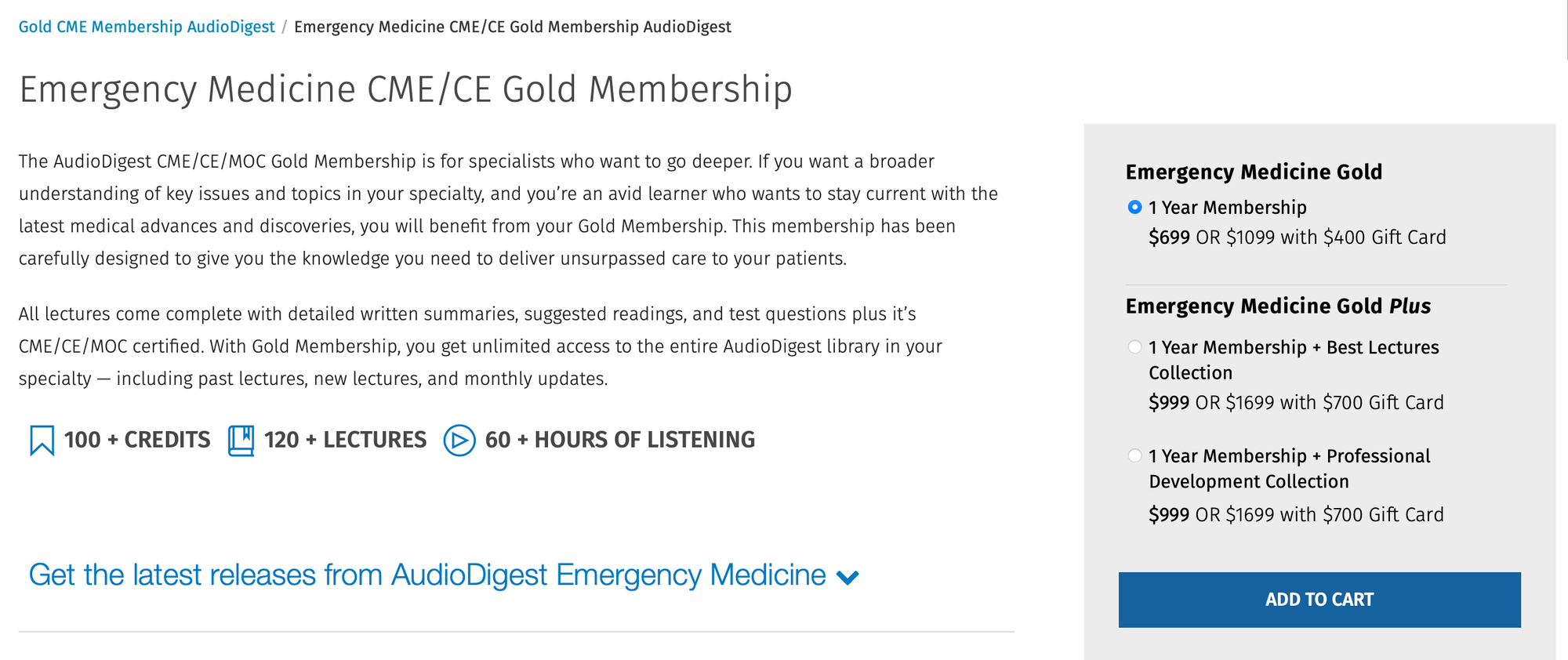
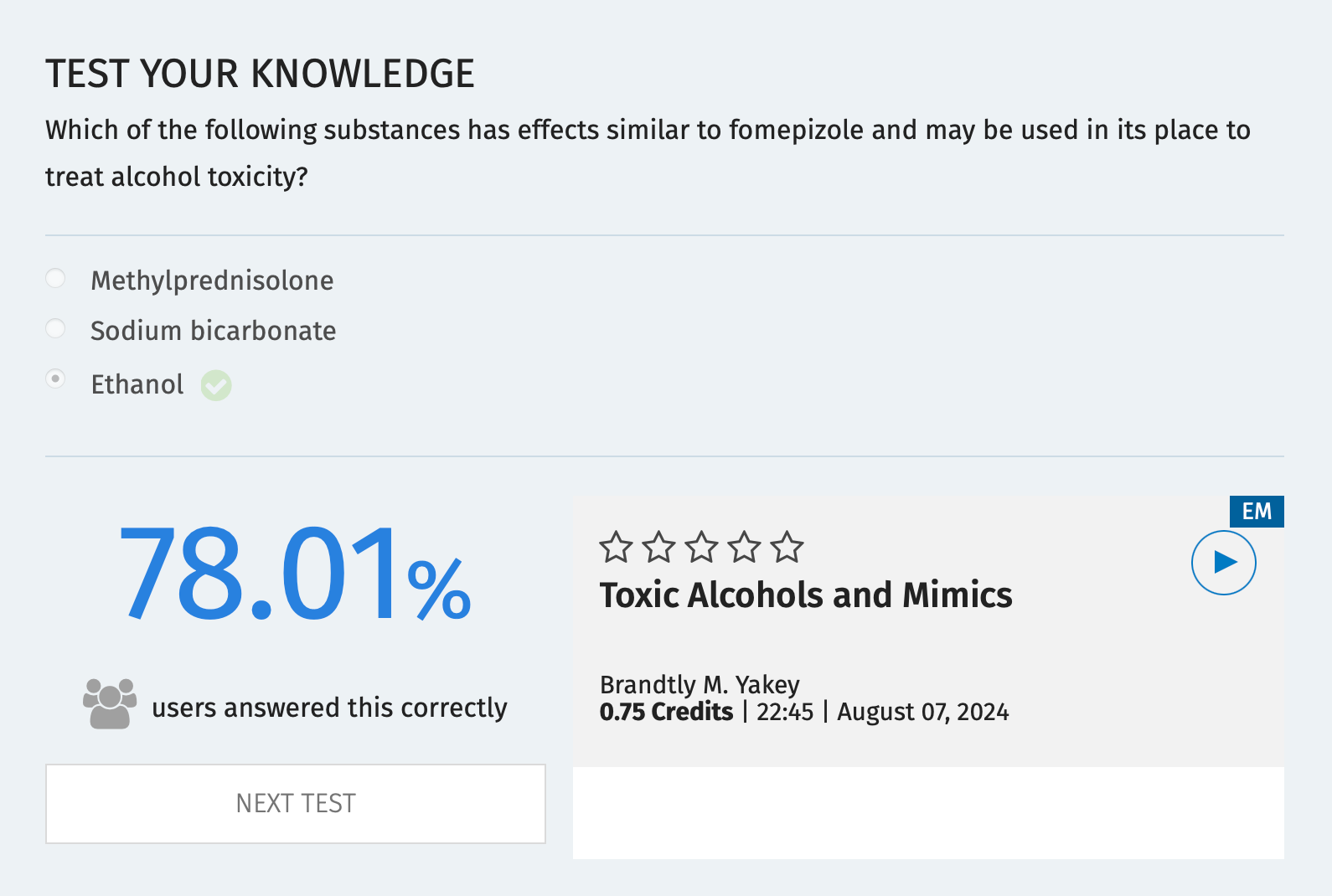
As you can see, it's $700 for the "base" membership and it renews annually, so you want to make sure you get the most out of it when you get an annual membership. Based on the screenshot below, I can see that each episode is worth X amount of credits, so it's easy to track that way.
How many credits can you claim in UpToDate? Based on what I'm seeing, there is no limit. However, different state boards may require X number of hours in certain topics (see above).
Also, the amount of Category 1 credits that you can get from UpToDate differ by specialty; you can find the link to this breakdown here.
For instance, for emergency medicine, it tells you: "Approved by the American College of Emergency Physicians for a maximum of 30 hour(s) of ACEP Category I credit." (That's pretty good.)
For family medicine, it says: "The AAFP has reviewed UpToDate and deemed it acceptable for up to 20.00 Point of Care* AAFP Prescribed credit(s)."
As you can see, it's different not only for every state but also every specialty. It is your responsibility to keep this in mind when you are making your choices.
*Understanding what a "prescribed credit" is for AAFP is outside the scope of this article (and my understanding, truth be told), but you can read much more about it here.
How do you keep track of and submit your CME? Good question. There is no one right way. Here are some suggestions/options:
- Use the CME tracker (each specialty might offer its own, like ACEP has one for emergency medicine) or you can use the ACCME one (linked here)
- these are for all the formal/reported credits, as far as I can tell
- Track it yourself in a Google Sheets or Excel (specifically helpful for Category 2 or informal credits)
- Save all the proof in a folder on your computer
PSA for New Residency Graduates:
For some specialties, like emergency medicine, you can earn CME for passing the oral board exam. I don't know if that's true for every specialty but definitely worth looking into.

Amazing!
Hope that was helpful. Please comment with any corrections, advice or insight – I'm still learning.
References: